16 September 2026
About the research
This project examines how developing economy governments can design and sequence national carbon pricing frameworks, combining international mechanisms with domestic instruments to advance climate goals without stalling growth.
The challenge: closing the gap between ambition and action
Following COP30, most developing countries have updated their Nationally Determined Contributions (NDCs) and committed to net-zero targets. Yet practical implementation remains elusive. Governments face a compound problem; they lack the institutional infrastructure for sophisticated carbon markets while simultaneously managing debt constraints, energy poverty, and the need for sustained economic growth. The conventional wisdom holds that domestic carbon pricing must come first, with international market engagement reserved for systems that have already matured. This report argues an alternate assumption.
Data and method
The study employed a five-phase methodology. This included a systematic literature review drawing on UNFCCC, World Bank, and OECD sources, a quantitative mapping of 41 sovereign carbon pricing instruments across income group and governance profile, and comparative case studies of seven jurisdictions including Singapore, South Korea, Kazakhstan, Mexico, and the EU. The research also assessed Article 6.2 bilateral approaches, Article 6.4 crediting mechanisms, and voluntary market standards. Findings were validated through a country case study of Oman. The World Bank's Mitigation Action Assessment Protocol (MAAP) served as the foundational tool for measuring jurisdictional readiness throughout.
Key findings
Cross-case analysis revealed a consistent pattern. High-performing systems such as Singapore's carbon tax and South Korea's K-ETS all adopt a phased approach of having an established monitoring, reporting, and verification (MRV) infrastructure before pricing, maintained credible price trajectories, and delivered transparent revenue recycling. Underperforming systems, including Kazakhstan and Albania, did the inverse; pricing preceded institutional capacity, were too low to drive behavioural change, and governance was weak.
The report's central argument is a strategic reversal. Developing nations should treat participation in Article 6 as a catalyst for building governance infrastructure, not as a reward reserved for mature systems. By entering Article 6.2 and 6.4 arrangements early, governments can fund MRV systems and legal frameworks through international credit revenues rather than domestic budgets. For nations facing declining official development assistance and tight fiscal constraints, this is not merely a strategic choice, it is a macroeconomic necessity.
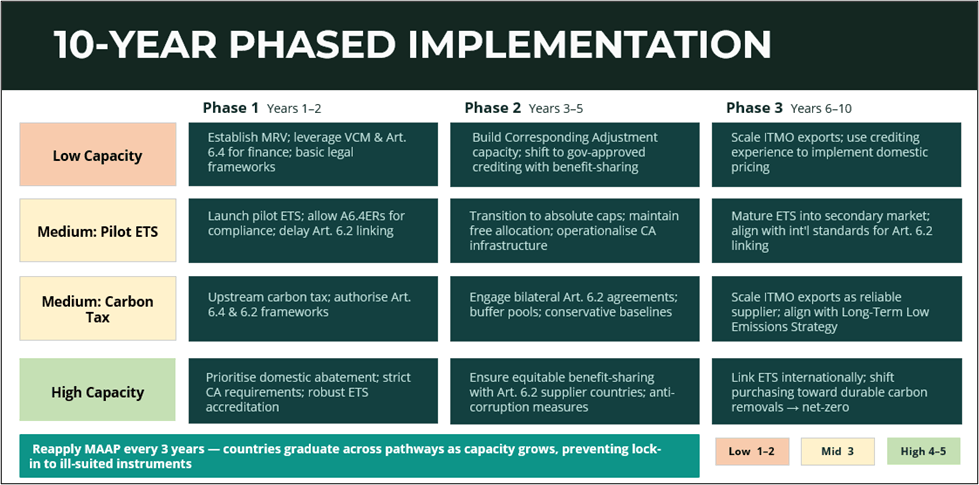
The framework offers three readiness-calibrated pathways, assigned using MAAP scores. Low-capacity countries begin with a modest upstream carbon tax combined with Article 6 pilots and voluntary market engagement. Medium-capacity countries choose between a pilot sectoral ETS or an upstream carbon tax with bilateral Article 6.2 trading. High-capacity countries deploy a comprehensive domestic ETS alongside a carbon tax, with ETS linkage negotiations and strict governance of voluntary markets. All three pathways are underpinned by six governance pillars, inspired from the Roadmap to Net-Zero Aligned Carbon Market Regulation by the University of Oxford: efficient financing, net-zero alignment, ecosystem integrity, equitable revenue-sharing, enforcement, and interoperable registry infrastructure.
Bottom line
Carbon pricing is feasible and effective in developing-economy contexts when sequenced according to institutional capacity. By treating Article 6 as the foundation rather than the finish line, governments can transform a compliance burden into a revenue-generating engine for climate governance.
Implications for decision makers and practitioners
For national policymakers, the priority is to establish the legal architecture for Article 6 authorisation and corresponding adjustments before launching a domestic carbon price and phasing out fossil fuel subsidies in parallel, to ensure that price signals can be transmitted effectively. For advisory firms such as Valor Carbon, initial engagement with low-readiness governments should focus on the foundational preconditions of MRV capacity, NDC alignment, and legal authorisation, rather than immediately selecting an instrument.
Our application of the developed framework on Oman shows how a hydrocarbon-dependent economy can enter global carbon markets through strategic Internationally Transferred Mitigation Outcomes (ITMO) positioning while deferring domestic pricing. For multilateral institutions and climate finance investors, capacity building should target Article 6 authorisation and transparent revenue recycling mechanisms, and investment should follow jurisdictions that are actively aligning domestic policy with Article 6 requirements, as these represent the most credible long-term counterparties.