13 October 2026

The challenge: capital is not enough
Africa faces a climate finance paradox: it is highly exposed to climate risks, yet constrained in accessing, mobilising and deploying finance at scale. The study investigates whether the problem is only a shortage of capital, or also a shortage of durable capacity: the skills, systems, institutions and coordination mechanisms needed to turn finance into implementation.
Comparing demand for capacity building with the supply of existing initiatives
The study uses a qualitative, multi-source design to compare demand for capacity building with the supply of existing initiatives:
- A content analysis of 45 African Nationally Determined Contributions (NDCs) 2.0, including English and French submissions, to identify stated capacity needs related to climate finance.
- Expert interviews with African and international practitioners from research, civil society, academia and climate finance.
- A global review of more than 60 academic and professional climate and sustainable finance courses.
- Nine case studies of major capacity-building initiatives, including fellowships, multilateral programmes, policy networks and youth-focused initiatives.
Capacity is the missing infrastructure: capacity needs are visible, but not yet investment ready
Finding 1: Needs are widespread, but often under-specified. Most African NDCs identify capacity building as essential for implementation. However, many do not clearly explain which finance-related capacities are missing, where institutional bottlenecks sit, or how much support is required. This weakens the ability of funders and governments to design targeted readiness support.
Finding 2: The gap is structural, not only technical. Countries need more than training in proposal writing. The study identifies recurring needs in project preparation, MRV and data systems, climate finance literacy, public financial management, inter-ministerial coordination, private-sector engagement and subnational implementation. Without these institutional conditions, trained individuals may have limited ability to change practice.
The core mismatch is between short-term training and long term institutional need
Finding 3: Supply does not fully match demand. The capacity-building landscape is expanding, but many initiatives remain short-term, donor-driven and weakly embedded in national systems. Existing programmes often emphasise stand-alone technical training, while countries require longer-term support for project pipelines, data systems, national climate finance strategies and implementation capacity.
Finding 4: Access remains uneven. Many courses are delivered in English, located in or designed by Global North institutions, or require fees and professional prerequisites that exclude early-career practitioners, subnational actors and locally embedded organisations. Inclusion is therefore not only about enrolment; it is about who can convert learning into sustained institutional roles.
The missing link: capacity as the operating system of climate finance
Africa’s climate finance challenge is not only that too little money is flowing. It is also that the systems needed to channel, manage and sustain finance remain underdeveloped. This is the missing link in the climate finance architecture.
As Figure 1 shows, climate finance capacity depends on the interaction between technical, human, technological and institutional capacity.
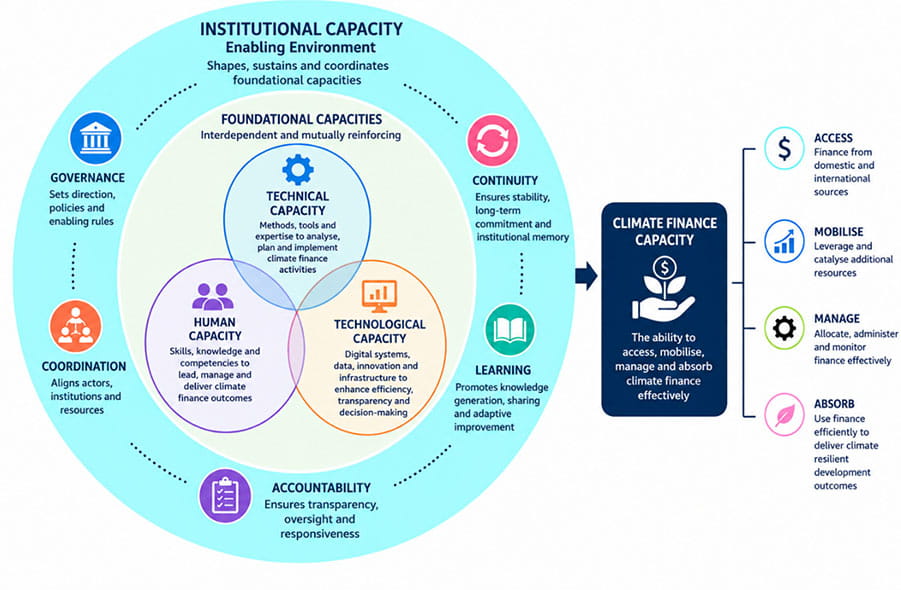
Technical expertise, skilled people are appropriate technologies together determine the ability to access, mobilise, manage and absorb climate finance effectively. Institutional capacity provides the enabling environment that connects and sustains these capacities. Governance, coordination, accountability, continuity and learning determine whether climate finance can be translated into implementation and long-term impact. Without strong institutions, finance may remain promised but not effectively delivered or absorbed.
Capacity building should therefore not be treated as a peripheral activity, but as a strategic investment in the systems, institutions and people that enable climate finance to deliver real outcomes.
Read the full paper
Capital without Capacity? The Missing Link in Africa’s Climate Finance Architecture
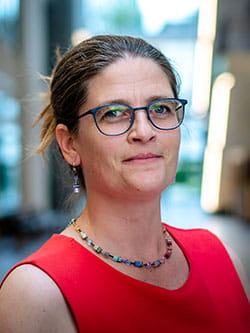
Christine Grüning
Director at the Executive Education Department of Frankfurt School of Finance & Management.

Karishma Ansaram
Lecturer in Climate Finance and Investment at the University of Edinburgh Business School .